
Air Monitoring Surveys
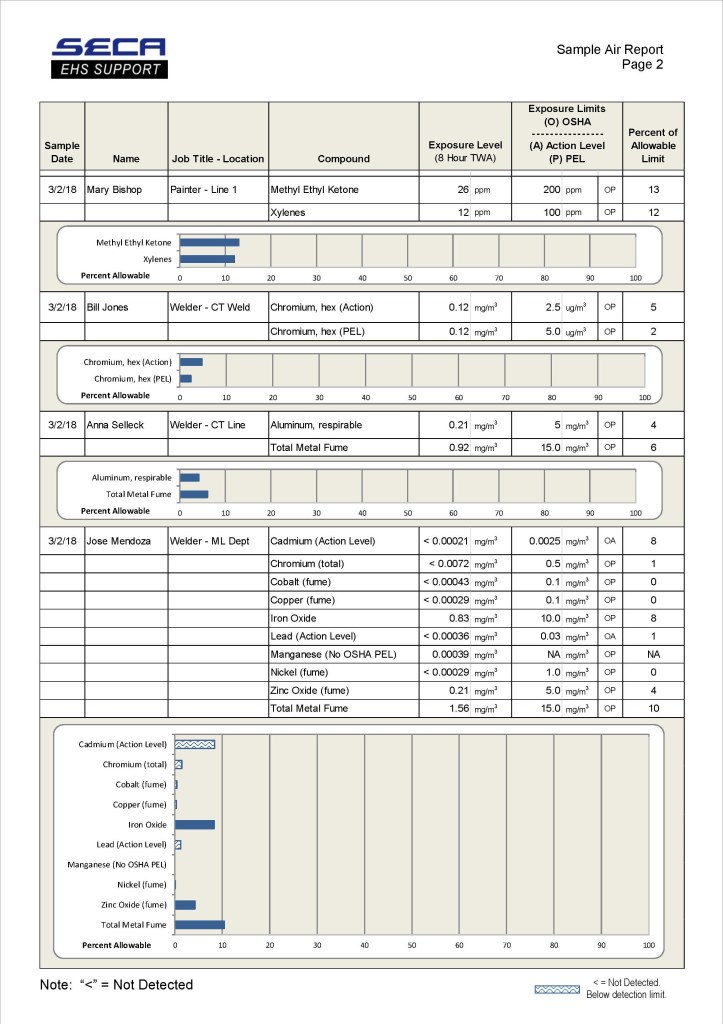 A page from a real air monitoring report
See sample report pages →
Most people come to us after something has happened: an inspector asked what your welders are breathing, a new material showed up on the floor, or someone wants a number and no one in the building has one. We come out, put sampling pumps on your people for a full shift, and deliver a report that states what they were exposed to and what that requires you to do.
What we do
We sample people, not rooms. On the day of the survey, that means:
- The pump goes on the belt and the filter or tube clips to the collar. That makes it a personal sample, taken in the worker's breathing zone.
- We sample the full shift, on the person doing the job. A two-hour sample from the quiet part of the morning tells you very little that will stand up later.
- We sample for silica, hexavalent chromium, welding fume, lead, solvents and isocyanates. That list covers most of what a manufacturing plant needs to know about.
- Every sample goes to a nationally accredited laboratory (accredited under the federal NVLAP program).
While the pumps run, we are out on the floor observing the work: how the part actually gets ground, whether the bay door gets propped open in August, and what second shift does differently. Those details determine whether a result represents the job or only represents Tuesday.
How many samples you need
You need fewer than most people expect. The count has almost nothing to do with headcount and is set by how many truly different jobs you have.
Twelve welders running the same weld on the same alloy in the same bay are one similar exposure group (SEG), meaning a set of workers who do the same job the same way. The one person in the plating room is a separate exposure group. We work that out with you before anyone books a flight, so you know the scope of the project going in.
What the report gives you
The report gives results for each person and each job, compared against the exposure limits that apply to your operation. We write it so the person who has to act on it can read it without a translator.
When you don't need us
You may not owe anyone new monitoring if all three of these are true:
- You had air monitoring done in the last year.
- Nothing about the material or the process has changed.
- The results came back well under the limit.
Send us the previous report and we will tell you what it still covers.
Common questions
What is an air monitoring survey?
An air monitoring survey measures the airborne contaminants your workers are exposed to on the job. Each worker being sampled wears a small pump on the belt for a full shift, with a filter or tube clipped to the collar in the breathing zone. A nationally accredited laboratory analyzes the samples, and the report compares each person's exposure with the limits that apply to your work.
We sample for silica, hexavalent chromium, welding fume, lead, solvents, isocyanates and other substances. See the full list and each step of a survey.
How do I know whether we need an air monitoring survey?
Most clients come to us after something has raised the question: an inspector asked what your welders are breathing, a new material showed up on the floor, or someone wants an exposure number and no one has one.
OSHA has substance-specific standards for certain contaminants. Where workers may be at or above the action level, which is usually half the permissible exposure limit (PEL), those standards require you to assess their exposure. The trigger is not the same for every substance, and a short conversation usually shows whether you need a survey.
What happens on the day of the survey, and what do our workers have to do?
The day starts before the shift, with a calibration check on every pump. Each worker being sampled wears a small pump on the belt with a filter or tube clipped to the collar, then does the normal job for the full shift. The pumps are checked during the shift and come off at the end.
While the pumps run, the person running the survey stays on the floor observing the work and recording what is running, which controls are in use, and anything unusual about the day.
Do we have to shut down production for the survey?
No, and you should not. We sample while you run, because a normal production day is the only kind that gives you data you can rely on later. A survey taken on a slow day describes only a slow day.
We will ask what a normal shift looks like and choose one, including second shift if that is where the work actually happens.
How long will you be on site, and when do we get results?
Most single-substance surveys take one day on site, while projects that cover several substances or several shifts run two to three days. The field day runs from before the shift starts until the last pump comes off.
Laboratory turnaround comes on top of the field day, and we give you a realistic delivery date when we plan the project, not afterward. Rush laboratory service is available, but it is worth paying for only if you are up against a deadline.
How many air samples will we need?
More than one, and fewer than most people fear. The count depends on how many truly different jobs you have, not on headcount. Twelve welders running the same weld on the same alloy in the same bay count as one job.
A survey samples a few people from each similar exposure group, meaning workers who do the same job the same way, and their results represent the group. There is no fixed number. It depends on how many distinct jobs there are and how much the work varies, and even a couple of samples on a job begin to show the range. The count is settled after a look at the floor, and it goes in writing before the survey. More on how many samples you need.
Who performs the survey, and do you travel to us?
SECA is a small Arizona firm. Ron Fleming has walked plant floors since 1993 and plans every project himself, and his son Marcus has joined the business and is learning it on site with him. You deal directly with the person who does the work.
We are based in Arizona and work on site across the United States. A survey is a one- to three-day visit, so travel is a modest share of the total cost.
What does the air monitoring report include?
A complete report gives results for each person and each job, compared with the permissible exposure limit (PEL) and the action level that apply to you. It shows the calculation behind each 8-hour time-weighted average (TWA), states the periodic monitoring schedule your results trigger, and gives recommendations in plain language.
It also identifies the laboratory and the analytical methods by number, and it should be written so the person who has to act on it can read it. See sample reports.
Do we have to notify our workers of the monitoring results?
For substances with their own OSHA standard, yes. You have 15 working days, whether the numbers are good or bad, to notify each worker in writing or post the results where workers can see them. The clock starts at different points: for lead it starts when you receive the results, and for silica it starts when the exposure assessment is complete.
If a result is above the permissible exposure limit (PEL), the written notice must also say so and describe your corrective action. Substances that have a PEL but no standard of their own carry no such requirement. The notice is best drafted along with the report, and most employers find the conversation goes better than expected.
What happens if a result exceeds the permissible exposure limit (PEL)?
For substances with their own OSHA standard, a result above the permissible exposure limit (PEL) starts four things at once. You must notify workers within 15 working days and describe your corrective action. The standards require respirators while you work on the correction, and they require feasible engineering controls, such as ventilation, before you rely on personal protective equipment. For most of these substances, you must also repeat the monitoring sooner.
How soon depends on the substance: every 3 months for silica and for lead, and every 6 months for benzene. Do not resample right away in the hope of a better number. We walk you through each step. What to do when a result exceeds the PEL.
How often is exposure monitoring required?
There is no single answer, because OSHA has no general schedule and each substance-specific standard sets its own.
Take silica. If your initial result is below the action level, you may stop monitoring. At or above the action level you monitor again every 6 months, and above the permissible exposure limit (PEL) every 3 months. Benzene runs on a slower schedule: yearly at or above the action level, and every 6 months above the PEL.
A change in your process, equipment, personnel or work practices that may raise exposure also calls for new monitoring. See the monitoring schedule for each substance.
What does an air monitoring survey cost?
We do not publish prices, because the price depends on details we can only learn from you. Those details are how many truly different jobs you have, which substances are involved, how many shifts we need to cover, and how far we are traveling.
A short planning call is enough. After it, we send a written scope of work and a fixed price before anything is scheduled. Sampling for several substances in one visit costs less than separate visits, because the field day is the same. See what drives the cost.
We already issue respirators. Can we skip air monitoring?
Almost certainly not. OSHA's respiratory protection standard requires a reasonable estimate of worker exposure, and if you cannot make one, you must treat the atmosphere as immediately dangerous to life or health. You also cannot select the right respirator without an exposure number, and OSHA's substance-specific standards have no exemption for personal protective equipment.
Often the monitoring shows levels well below the limits, in which case the respirator program can be scaled back or made voluntary. More on respirators and air monitoring.
We already have air monitoring data. Is it still valid?
Possibly. It may still cover you if nothing about the material, the process or the controls has changed and the results were well under the limit. Several OSHA standards allow you to rely on earlier monitoring results or on objective data.
Lead is stricter than most people expect, because its standard accepts only lead air measurements made in the past 12 months. Periodic monitoring is a separate question. Send us the report and we will tell you what it still covers. When existing data can replace new samples.
Can we buy sampling pumps and do the monitoring in-house?
You can, and some plants with a full-time environmental, health and safety person do. The difficult part from the inside is what makes the data defensible. You calibrate each pump against a reference flow meter before and after the shift. You group workers by task, not by job title, and you write field notes while the work is happening.
Surveys usually fail on the documentation, not the chemistry.
Is there a free option we should consider first?
In Arizona, yes. ADOSH, the state OSHA plan, runs a free on-site consultation program that does include air sampling and is separate from enforcement. For some employers it is plainly the right place to start, and we will say so.
The program is aimed at smaller businesses in higher-hazard industries, so larger manufacturers get low priority. If you do not act on an imminent danger, or do not correct a serious hazard in the agreed time, the consultant must refer it to enforcement. The program is also not set up to build a record for a contested case. Compare the free program with hiring a consultant.
No cost and no pressure. If you do not need the work, we will tell you so.
References
The regulations and standards behind this page, with links to the official text, so you can check the source yourself.
- OSHA 29 CFR 1910.1053(d) Respirable Crystalline Silica