
Noise Surveys
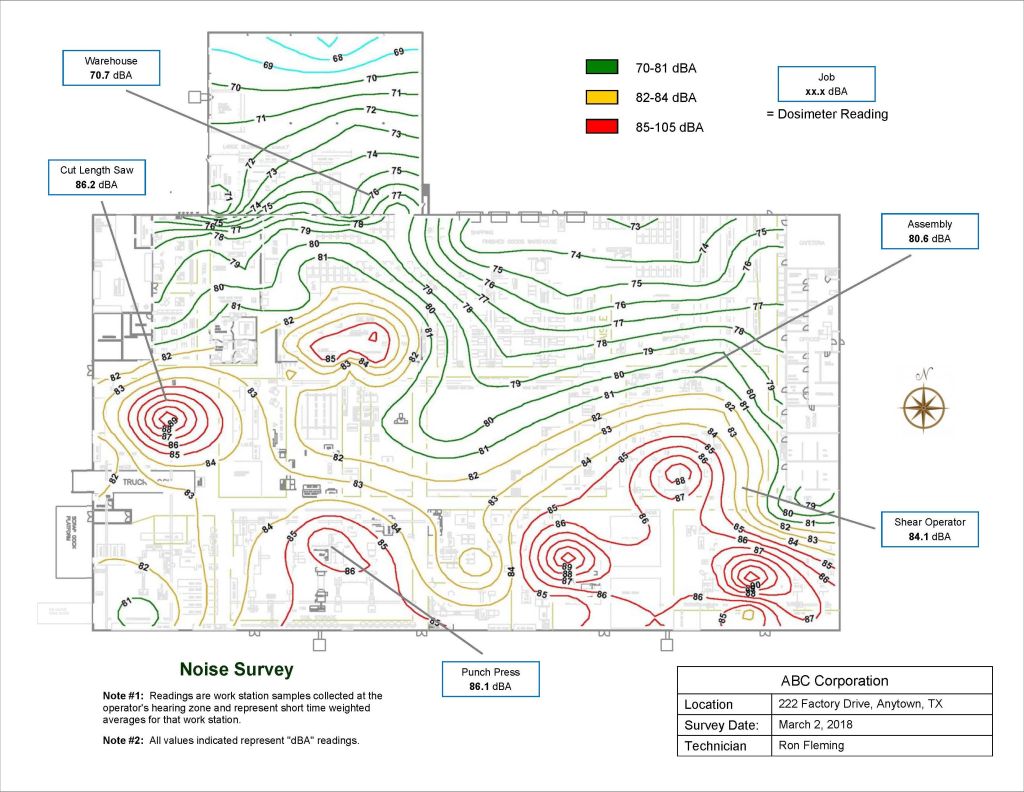 A sound level map from a real survey
See sample report pages →
Most clients come to us because an employee failed a hearing test, or because an inspector asked for a noise survey that had never been done. We come out, put noise dosimeters on your people for a full shift, and walk the floor with a sound level meter. Then we tell you plainly which jobs are over the limits and which are not.
What we do
We arrive before the shift starts, because a noise survey that begins at ten o'clock has already missed the part of the day you most needed to know about. From there:
- Noise dosimeters go on the people who do the work. They wear the dosimeters for the full shift, not a sample of it.
- We build a sound level map of the floor, using a sound level meter while the dosimeters run.
- We run a calibration check on every dosimeter after the shift, and we document it.
- You get results by person and by job, not one averaged number for the building.
The map matters more than most people expect. Noise is rarely where the plant thinks it is, and walking the floor with a meter is how that comes to light.
What the report tells you
The report identifies which workers are over the action level and which are over the permissible exposure limit (PEL), and it states what each of those results requires you to do next.
You may need a hearing conservation program. If you do, we say so and tell you what goes into it, and if you don't, we say that too.
When you don't need us
Some plants are genuinely quiet: offices and light assembly, with no compressed air and no presses. If that describes your plant, you may not need a survey at all, and a short conversation usually settles it. We would rather have that conversation than send someone out for a day.
Common questions
What is a noise survey?
A noise survey measures the noise exposure your workers receive on the job. Workers wear noise dosimeters for a full shift, and while those run, a walk of the floor with a sound level meter builds a sound level map.
You get results by person and by job, not one averaged number for the building. The report states plainly which jobs are over the line and which are not, and what each result requires you to do next. See how a noise survey works, step by step.
How do I know whether we need a noise survey?
OSHA sets a low trigger. You need a monitoring program when information indicates that any worker's exposure may equal or exceed an 8-hour time-weighted average (TWA) of 85 decibels (dBA). You do not have to know that workers are over 85, so if your plant is loud enough that you are wondering, you are already inside the trigger.
There are some rough indicators: you cannot hold a normal conversation at 3 feet, people have to shout to be understood, or ears ring at the end of a shift. These are a rough guide, not a survey.
What noise levels trigger OSHA requirements?
OSHA's noise standard has two levels. The first is the action level, an 8-hour time-weighted average (TWA) of 85 decibels (dBA), and reaching it requires a hearing conservation program. The second is the permissible exposure limit (PEL), an 8-hour TWA of 90 decibels, which is where feasible engineering or administrative controls come in. Engineering controls are built into the job, and administrative controls change how the work is run.
You cannot judge either level by ear. A very loud machine that someone stands beside for an hour often matters less than a moderate one they work around all day.
When would you tell us a noise survey is not needed?
We would tell you that when your facility is truly quiet, such as offices and light assembly with no presses and no compressed air. In that case you may owe nothing at all, and a short conversation usually settles it.
The same applies if you were surveyed recently and nothing has changed, meaning no new line, no relocated production and no new equipment. Noise data goes stale when the plant changes, not on a calendar. Describe your operation and we will tell you whether you are in the range where this matters.
What happens on the day of the survey, and what do our workers have to do?
The day starts before the shift, with a calibration check on each noise dosimeter. One goes on each worker being monitored, with the microphone on the shoulder near the ear. Your workers then do their normal jobs for the full shift, and the dosimeter stays on through breaks and lunch as they actually take them.
While the dosimeters run, a walk of the floor with a sound level meter builds the sound level map. The field notes record what ran, what did not and what was not normal, because a survey done on a slow day describes only a slow day. After the shift, the calibration of every dosimeter is checked again and the result recorded.
How long do workers wear the dosimeters?
Workers wear the noise dosimeters for the full shift. A dosimeter measures the noise dose that accumulates over the day, so two hours from the middle of the day does not answer the question. The calibration of each dosimeter is checked before it goes on and again when it comes off, and both checks are recorded.
If you run three shifts and they differ from each other, tell us on the planning call, because that changes the scope of work. You cannot learn what second shift is exposed to by monitoring first shift.
How many workers need to be monitored?
Not everybody. OSHA's noise standard sets no headcount requirement. Noise dosimeters go on enough people in each group to show what the whole group is exposed to. A group is defined by what a person's noise dose looks like over the shift, not by job title or department.
A small machine shop with one shift and everyone in one bay typically has 2 to 3 groups and uses 4 to 8 dosimeters. Groups that land close to the action level deserve more dosimeters than groups far above or below it. More on how many workers to monitor.
How long are you on site, and when do we get the report?
Most single-shift surveys take 1 day on site. The noise dosimeters go on before the shift starts and come off after it ends, and someone has to be there for both. Plants that run 2 or 3 shifts need either more days or a return visit.
You know the report schedule before we start. After a short planning call, we send a written scope of work and a fixed price. The scope states the turnaround time, along with the number of dosimeters, the area we will survey and what you will receive.
Who performs the survey, and do you travel?
SECA is a small Arizona firm. Ron Fleming has walked plant floors since 1993 and plans every project himself, and his son Marcus has joined the business and is learning it on site with him. You deal directly with the person who does the work.
We are based in Arizona and work on site across the United States.
What does the noise survey report include?
For each worker monitored, a complete report gives the 8-hour time-weighted average (TWA), the dose as a percent, the maximum and peak levels, and the shift length used in the calculations. For each group, it states whether the group is over the action level, over the permissible exposure limit (PEL) or clear. It includes the sound level map, and it evaluates whether your hearing protectors provide enough attenuation for the noise measured.
It then states what each result requires you to do, and by when. What belongs in a noise survey report.
What do we have to do if a job is over the action level or the permissible exposure limit?
If workers are at or above the action level, you have a hearing conservation program to build. OSHA's noise standard requires audiometric testing, hearing protectors, annual training and recordkeeping, for every affected worker. Each worker measured at or above the action level must be notified of the results. Above the permissible exposure limit (PEL), feasible engineering or administrative controls are required as well.
The program is ongoing, not a one-time correction, and the honest course is to say so with the report. We measure the noise and tell you what belongs in the program. Running the audiometric testing, the training and the program itself is outside the four fields we work in. What a hearing conservation program requires.
When does a noise survey have to be repeated?
Not on a calendar, because OSHA's noise standard sets no annual schedule for a new survey. It requires new monitoring when a change in production, process, equipment or controls increases noise exposure enough to do one of two things. One is that more workers may be at or above the action level, and the other is that the hearing protectors in use may no longer provide enough attenuation.
A change that lowers the noise, or leaves it where it was, does not by itself require a new survey. Keep the report, and note the production conditions under which it was taken.
What does a noise survey cost?
We do not publish prices. The price depends on how many different groups of workers you have, how many shifts we cover and how far we travel. It also depends on whether you need octave band analysis, a breakdown of the noise by frequency, to plan engineering controls. Headcount matters far less than people assume.
If you are due for air monitoring as well, running both on one visit means you pay to get someone to your plant once, not twice. After a short planning call, you get a written scope of work and a fixed price. See what drives the cost of a noise survey.
We already issue earplugs. Can we skip the noise survey?
Not for deciding whether you owe a hearing conservation program. The action level is determined with no credit for hearing protection, so issuing earplugs does not put anyone below an 8-hour time-weighted average (TWA) of 85 decibels (dBA). It only protects the worker inside a program you are still required to run.
Hearing protection can count toward the permissible exposure limit (PEL), which is a different question with a different answer. Above its table of permissible noise exposures, OSHA's noise standard requires feasible engineering or administrative controls. If those fail to bring the noise within the table, personal protective equipment must be provided and used to do it.
Can we buy a noise dosimeter and do the survey in-house?
Buying a noise dosimeter is not hard. What does not come in the box is the part that makes the number defensible. You need calibration records showing that each dosimeter was checked before and after every use, careful work in the field, and a written rationale for which workers represent which group.
A hand-held sound level meter cannot do the job alone. It tells you how loud one location is at that moment, but it cannot tell you how much noise a worker actually received over the shift. More on personal noise dosimetry.
No cost and no pressure. If you do not need the work, we will tell you so.
References
The regulations and standards behind this page, with links to the official text, so you can check the source yourself.
- OSHA 29 CFR 1910.95(d)(1) Occupational Noise Exposure